
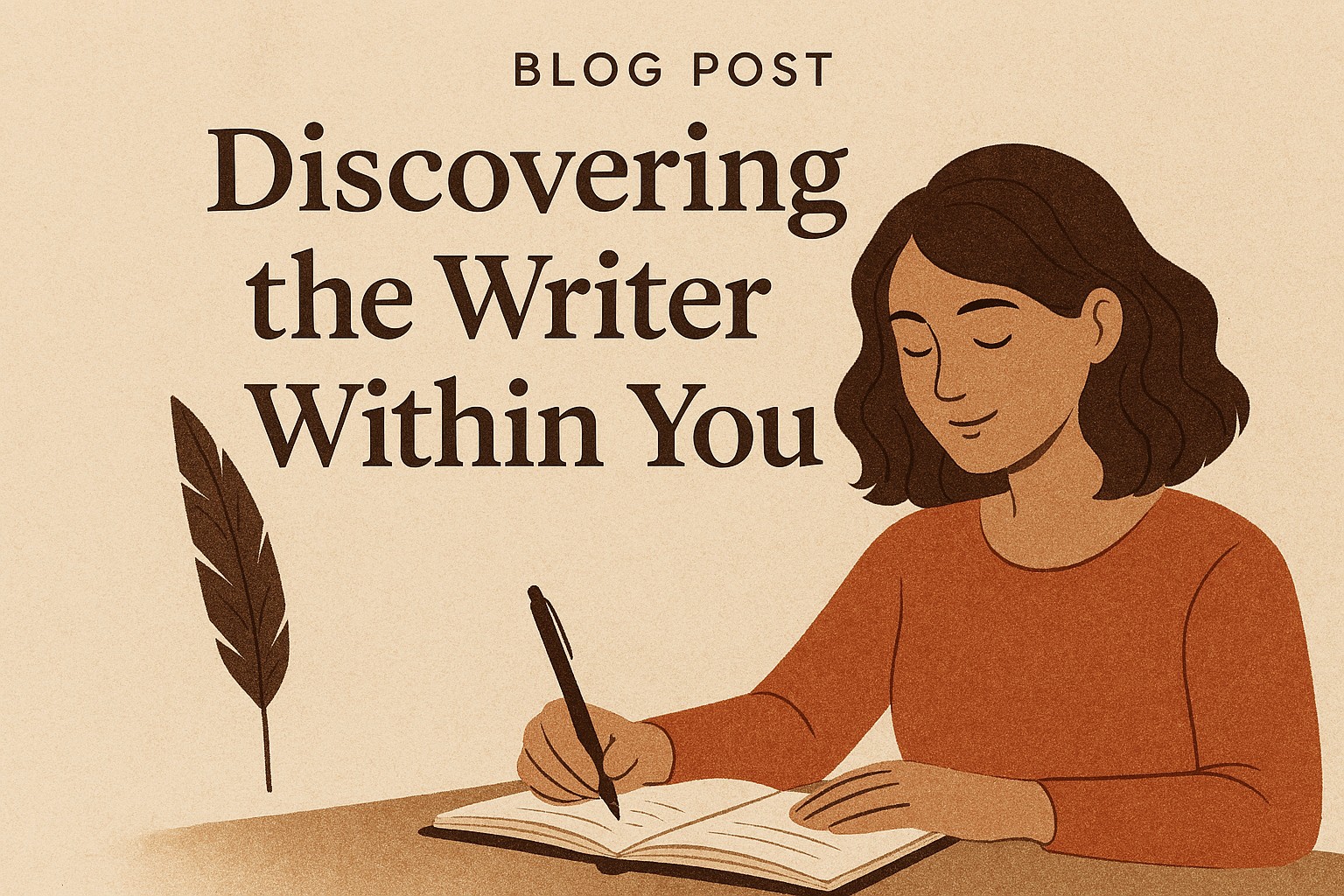
We all have stories inside us—memories, observations, emotions, and what-ifs—that quietly demand expression. But discovering the writer within isn’t about being born with a special gene or waiting for inspiration to strike. It’s a journey of curiosity, practice, and courage. Whether you want to write a novel, journal for clarity, craft poetry, or simply communicate more effectively, this blog will help you begin and keep going.
Why writing matters
- Writing organizes thought. When you put an idea into words, you clarify and refine it.
- Writing connects. Stories and essays build empathy and share perspective.
- Writing changes you. The act of reflecting on experience reshapes how you understand yourself and the world.
If that sounds appealing, the good news is: everyone can learn to write better. The more important question is: are you willing to practice?
Move past the myths that hold people back
- Myth: “You either have talent or you don’t.”
Truth: Skill grows through consistent practice, feedback, and reading. Talent helps, but effort matters more. - Myth: “First drafts must be great.”
Truth: First drafts are for discovery. Editing is where craft happens. - Myth: “I need perfect grammar or I can’t call myself a writer.”
Truth: Clarity and honest voice matter more than perfection. Mechanics can be learned.
Knowing these truths frees you to write imperfectly—and to improve.
Build a sustainable writing habit
A reliable practice beats sporadic brilliance. Try this simple framework:
- Start small: 10–20 minutes daily is more powerful than a single 5-hour session per week.
- Use a ritual: same time or place, a favorite mug, a playlist, or a pen that feels good—consistency cues your brain.
- Set achievable goals: a daily word count, a weekly short piece, or finishing a single scene.
- Track progress: a calendar or habit app helps you keep momentum and celebrate streaks.
Consistency trains your creative muscles and reduces the dread of starting.
Exercises to discover your voice
- Freewrite for 10 minutes daily: set a timer and write without editing. Ignore grammar, logic, or neatness.
- Character sketch: create a 500-word biography for a person who would never exist in your life—give them a secret.
- Memory snapshot: pick a childhood moment and describe it with sensory detail—what you saw, smelled, felt, tasted.
- Rewrite a news headline as a short scene: take an item from the paper and dramatize it.
- Constraints: write a 300-word scene without using the letter “e.” Constraints push creativity.
Do each exercise repeatedly. Voice emerges when you notice patterns—turns of phrase, humor, rhythm—that recur.
Learn craft through reading and reverse-engineering
- Read widely: fiction, essays, memoirs, journalism, poetry. Each form teaches different tools.
- Read like a writer: ask how the author opens a scene, builds tension, uses dialogue, or shapes rhythm.
- Copy to learn: transcribe a page you admire to feel the cadence and sentence structure (for learning only—don’t publish it).
- Study craft books and essays: look up books on plotting, dialogue, showing vs. telling, and revision.
Seeing how other writers solve problems gives you techniques to try in your own work.
Get feedback without losing your voice
- Join a writing group or workshop—regular critique accelerates growth.
- Ask for targeted feedback: e.g., “Does this scene show the relationship clearly?” instead of “Is this good?”
- Learn to filter: take what helps, leave what doesn’t. Feedback is a tool, not law.
- Preserve time for private writing: not everything needs to be public or judged.
Balancing openness to critique with faith in your instincts helps your voice evolve, not dissolve.
Revision: where real writing happens
- Let drafts rest before revising. Distance reveals what’s missing or redundant.
- Focus each pass: one for structure, one for character/motivation, one for language and sentences.
- Cut ruthlessly: weaker scenes and sentences steal energy from stronger ones.
- Read aloud: awkward sentences and cadence problems become obvious when heard.
Revision turns fragments into a polished piece. It’s how intent becomes art.
Publishing and sharing (options for every level)
- Keep reading, submitting, and learning—rejection is part of the process, not a verdict on your worth.
- Start small: blogs, local literary magazines, or social media threads can build audience and confidence.
- Consider hybrid paths: self-publishing, newsletters, or serialized fiction.
- Remember: you’re writing for a specific reason—clarity, connection, career, catharsis. Let that reason guide your path.
Prompts to get you started (10-minute sprints)
- Describe an ordinary object as if it holds a secret.
- Write a letter to your younger self at age 12.
- The day the power went out, everything changed—start in the middle of that day.
- A stranger returns something you didn’t know you’d lost.
- A childhood fear revisited as an adult—how has it changed?
- A conversation that goes silently—describe the thoughts rather than the words.
- Two people argue about something trivial; it’s actually about something deeper.
- Your city as a living organism.
- A memory you wish you could forget—what makes it sticky?
- Rewrite a well-known fairy tale from the villain’s point of view.
Try a different prompt each day for two weeks. You’ll end up with a warm stack of new pieces and ideas.
Tools and resources
- Simple tools: a notebook, distraction-free writing apps (e.g., FocusWriter), or Scrivener for longer projects.
- Communities: local writing centers, Meetup groups, online workshops, Reddit writing subs, or literary forums.
- Books: pick craft books aligned with your goals (plotting, dialogue, memoir-crafting).
- Courses: short online classes or local college workshops can provide structure and feedback.
Choose tools that remove friction, not ones that create perfectionism.
Final encouragement
Discovering the writer within is less a destination than a daily practice. You will write badly at first. You will question whether it’s worth it. Keep going. The habit is the teacher; curiosity is your compass. Each sentence you write becomes evidence that you can do it again.
Start today—set a timer for 10 minutes and write. No title, no plan, just words. When the timer ends, you’ll have begun. We all need the courage to start somewhere. Start small—end big. I’m rooting for your success.
Happy writing, my friend,
James










Leave a Reply