
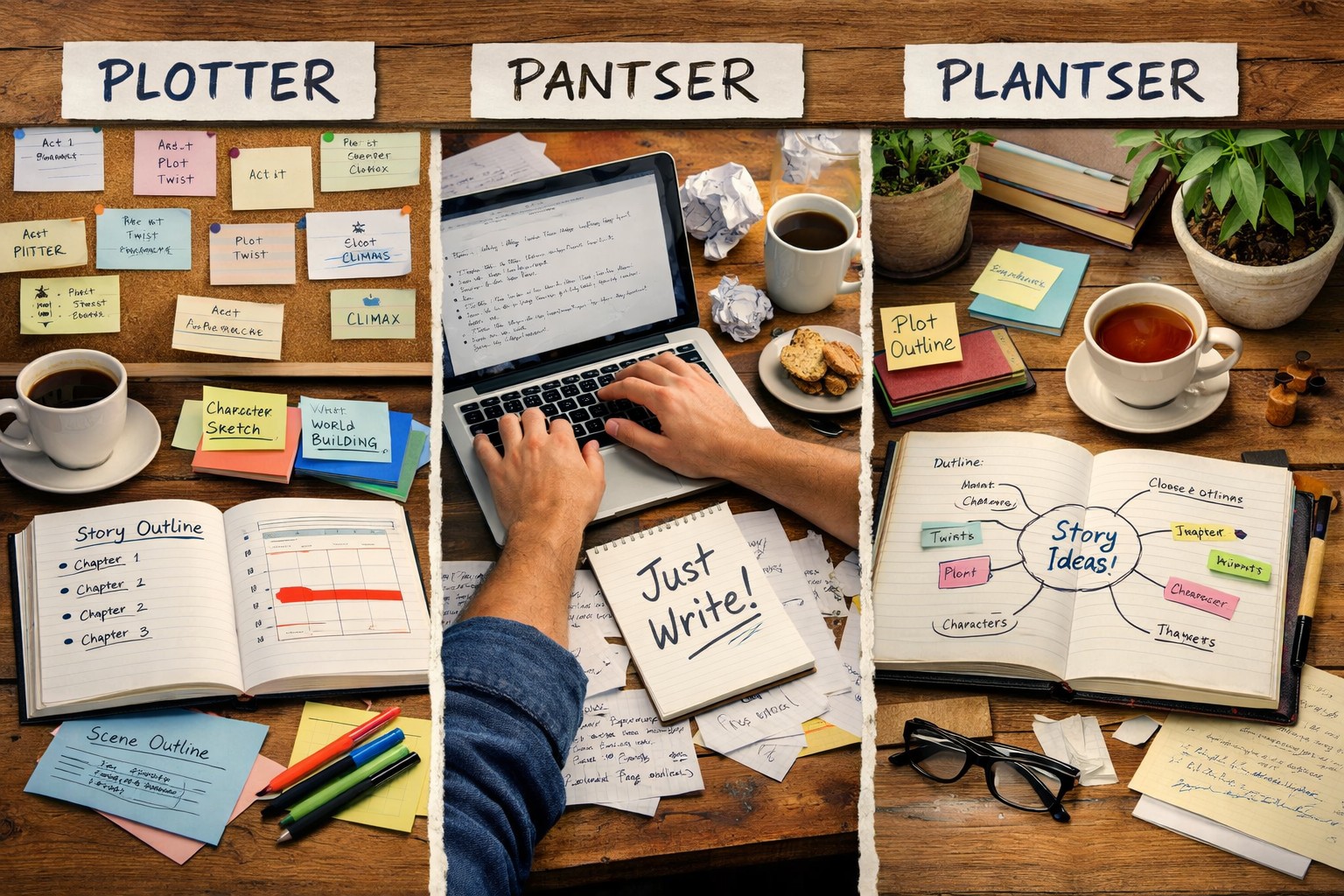
Writers love labels almost as much as they love coffee. Three of the most common: plotters, pantsers, and plantsers. They describe how a writer approaches story-making — from meticulously mapping every beat to wandering into scenes with no map at all, or sitting somewhere in between. None is “better”; each has strengths, challenges, and workflows that suit different personalities, projects, and stages of the writing life.
What they mean
- Plotter: Plans in advance. A plotter outlines, charts, and often knows the ending before writing the first scene. Tools: beat sheets, chapter synopses, timelines, character arcs. The plotter treats the novel like architecture built on blueprints.
- Pantser: Writes “by the seat of their pants.” A pantser discovers story as they go, relying on intuition, character momentum, and improvisation. They may write a messy first draft but often claim the discoveries and surprises are what fuel their best scenes.
- Planster / Plantser (hybrid): Uses both planning and discovery. A plantser sets up a skeleton — premise, key scenes, major turning points — and then allows the middle and details to be improvised. Think of them as planting seeds and letting a garden grow while pruning as needed.
Why different writers choose different approaches
- Personality: Some people are planners by temperament; others thrive on spontaneity. Neither is a moral choice — it’s a workflow preference.
- Project needs: Complex plots (mysteries, political thrillers, epic fantasy) often benefit from more planning to avoid contradictions. Character-driven or literary works sometimes benefit from discovery.
- Experience and confidence: New writers sometimes lean on outlines to avoid dead ends; others discover that outlines can feel stifling until they’ve learned craft.
- Time constraints: Authors who have to produce on deadline or write commercially might favor planning for efficiency.
Strengths and pitfalls
Plotters
- Strengths: Fewer plot holes, smoother pacing, easier drafting for long or complex stories; easier to break down production into manageable tasks.
- Pitfalls: Risk of stiffness or predictability, loss of discovery or surprise, planning paralysis (over-outlining and never writing).
Pantsers
- Strengths: Surprise, fresh scenes, dynamic character discovery, passionate writing energized by discovery.
- Pitfalls: Higher risk of meandering drafts, structural problems needing big rewrites, continuity errors.
Plantsers
- Strengths: Balance of structure and freedom; enough scaffold to avoid major rewrites but room for discovery and character-led scenes.
- Pitfalls: Could inherit pitfalls from both camps (not enough plan to prevent holes; not enough freedom to spark surprises) if not managed deliberately.
How writers actually work: rigid or fluid?
Few successful writers are purists. Many who call themselves plotters still leave space for scene-level discovery; many pantsers use checklists or note key beats. The term “plants er” exists because a lot of writers naturally fall in between — they like a safety net and a compass, not a map that dictates every step.
Practical workflows and tools for each approach
Plotter workflow
- Start with a one-sentence premise, then expand to a one-paragraph synopsis and a one-page outline.
- Create a chapter-by-chapter or scene-by-scene beat sheet. Mark inciting incident, 1st turning point, midpoint, climax, resolution.
- Build character sheets (goals, motivations, arc) and worldbuilding notes.
- Tools: Scrivener, Plottr, notecards, spreadsheets, index cards, or dedicated templates (Snowflake Method, Save the Cat beats).
Pantser workflow
- Start writing with a clear inciting incident or an intriguing character voice.
- Use loose scene goals (what the character wants in this scene) to avoid total drift.
- Keep a running “things to check later” list (continuity, timelines, unanswered questions).
- Tools: Plain document, voice recorder for ideas, freewriting prompts, or a dedicated “discovery draft” folder.
Plantser workflow
- Define the core: premise, inciting incident, major turning points (maybe three to five critical scenes), and the ending.
- Leave the middle scenes flexible. Use checkpoint outlines (e.g., “by chapter 10: X must have happened”).
- After a first-pass discovery draft, revise to fill structural gaps using targeted outlines for problematic sections.
- Tools: Mix of index cards for beats + a “scratch file” for free scenes; Notion/Milanote to combine structure and free notes.
Exercises to try each style (5–15 minutes each)
- For plotters: Write a one-page chapter-by-chapter outline for a story idea you have. If it’s longer than a page, condense it: what happens in each chapter?
- For pantsers: Set a 15-minute timer and write a scene where a character must make a small but clarifying choice (no planning beyond the premise). Don’t edit.
- For plantsers: Write a one-paragraph premise and three “must-have” scenes (inciting incident, midpoint twist, climax). Then freewrite a scene that could connect any two of them.
How to handle the most common problems
- Plot holes (pantser problem): Keep a “plot hole” list as you draft. During revision, build a mini-outline to plug the gaps.
- Stagnant prose (plotter problem): Schedule “discover” sessions where you write scenes without consulting the outline and let characters surprise you.
- Over-revision (plants er problem): If you keep tinkering, set a revision cap for each pass — focus on fixing one big thing (character, plot, pacing) per revision.
When to change approach
- If your drafts are always structurally weak, add more planning (scene lists, beats, timelines).
- If your text feels flat or overly mechanical, inject discovery experiments (dialogue-only scenes, freewriting, character interviews).
- Match method to project: try more planning for complicated plots; try discovery for character-led short fiction or experimental pieces.
Here are one widely recognized contemporary example for each category, with a short explanation of why they’re often placed there. Note: these labels describe tendencies, not rigid rules — many authors shift between methods or use hybrids.
1) Plotter — J.K. Rowling
- Why: Rowling is famous for extensive pre-planning of the Harry Potter series: timelines, character histories, and an overall series arc that she mapped out before finishing later books. She planned major plot beats and reveals in advance so threads could be planted early and pay off later.
- How that shows in the work: tightly woven foreshadowing, long-running mysteries, and consistent internal logic across seven books.
2) Pantser — Stephen King
- Why: In On Writing and interviews, King describes himself as a discovery writer who often starts with a situation or a character and lets the story emerge as he writes. He emphasizes the importance of following the characters and letting surprises happen in the draft.
- How that shows in the work: vivid, scene-driven narratives that can take unexpected turns and feel energized by discovery (though King still revises heavily afterward).
3) Plantser (hybrid) — Neil Gaiman
- Why: Gaiman has described a mixed approach: he sometimes begins with a clear premise, image, or a few key scenes and a sense of the ending, but he also allows the middle and many details to be discovered during drafting. That balance—planting key seeds, then letting the story grow—fits the plants er description.
- How that shows in the work: stories that blend a clear mythic structure or central idea with surprising, improvisatory scenes and character discoveries.
Short caveat
- These are simplified labels. Many contemporary writers don’t fit perfectly into one box: J.K. Rowling has admitted to discovering details while writing; King still uses structure and revision; Gaiman sometimes outlines more than he lets on. The useful part of these labels is to help writers understand different workflows and experiment with what works for them.
Finding your sweet spot: a short process
1) Try each approach for a small project (1,000–5,000 words) or a short story. 2) Notice where you felt energized vs. bored or frustrated. 3) Create a hybrid routine: build a minimal outline (3–6 beats) then write discovery scenes between the beats. Adjust until it feels productive.
Final thought
Writing style labels are tools, not prisons. Plotter, pantser, and plants er are useful words to describe tendencies, but the best approach is the one that helps you complete stories you’re proud of. Many writers shift depending on the book, the deadline, and their mood. Experiment, steal from other writers’ toolkits, and treat your process as another art you can shape.




Leave a Reply