
Writers talk a lot about plot. They talk less about structure. And when they do talk about structure, they often use it interchangeably with plot—as if the two are twins rather than distant cousins who only see each other at holidays.
But understanding the difference between plot and structure is one of the most powerful upgrades a writer can make. It’s the shift that turns a good story into a story that feels inevitable, propulsive, and architecturally sound.
Let’s break it down.
🧩 Plot: What Happens
Plot is the sequence of events—the external actions, choices, and consequences that move the story forward.
Think of plot as:
- The murder in chapter one
- The detective’s investigation
- The suspect who flees
- The twist that changes everything
- The final confrontation
Plot is content. It’s the what.
Plot answers questions like:
- What does the protagonist want
- What stands in their way
- What actions do they take
- What goes wrong
- What changes
Plot is the engine. Without it, the story doesn’t move.
But an engine without a chassis is just a pile of parts.
🏗️ Structure: How You Tell It
Structure is the arrangement of events—the order, rhythm, and pattern that shape how the reader experiences the story.
Structure is the how.
It includes decisions like:
- Where the story begins
- What information is withheld
- When revelations land
- How timelines intercut
- Which POV delivers which moment
- How tension escalates
Structure is the architecture that makes the plot feel meaningful rather than chaotic.
Two writers can use the same plot and produce wildly different stories simply by changing the structure.
🔍 A Simple Example
Plot: A woman disappears. Her husband becomes the prime suspect. She’s not dead—she staged the whole thing.
Structure A: Told chronologically from the husband’s POV. → Feels like a mystery.
Structure B: Alternating timelines: his present-day POV + her “diary” entries. → Feels like a psychological thriller.
Structure C: Start with the twist, then explore the fallout. → Feels like a character study.
Same events. Different experience. That’s the power of structure.
🎯 Why Writers Confuse the Two
Because when you’re drafting, plot and structure blur together. You’re discovering events and arranging them at the same time. But when you revise—or when you want to level up your craft—you need to separate them.
Plot asks: What happens next
Structure asks: What does the reader need next
Those are not the same question.
⚙️ How Plot and Structure Work Together
Think of plot as raw material. Think of structure as design.
Plot gives you:
- Conflict
- Stakes
- Causality
- Momentum
Structure gives you:
- Suspense
- Pacing
- Emotional resonance
- Thematic clarity
Plot is the story’s heartbeat. Structure is the circulatory system that makes the heartbeat matter.
🧠 Common Mistakes Writers Make
1. Relying on plot twists without structural setup
A twist without structure is just noise. Structure is what plants the seeds, misdirects the reader, and makes the reveal satisfying.
2. Writing scenes in the order they occur
Chronology is not structure. It’s just time.
3. Confusing complexity with depth
A story with multiple timelines isn’t automatically better. Structure should serve the emotional arc, not obscure it.
4. Treating structure as a template
Three-act structure, Save the Cat, the Hero’s Journey—these are tools, not commandments.
🧭 How to Strengthen Both
For Plot:
- Clarify your protagonist’s goal
- Raise stakes through consequences
- Ensure each scene changes something
- Escalate conflict, don’t repeat it
For Structure:
- Start as close to the disruption as possible
- Decide what the reader should know—and when
- Use POV strategically
- Experiment with order during revision
Structure is where you craft the reader’s emotional experience. Plot is where you craft the character’s journey.
✨ The Takeaway
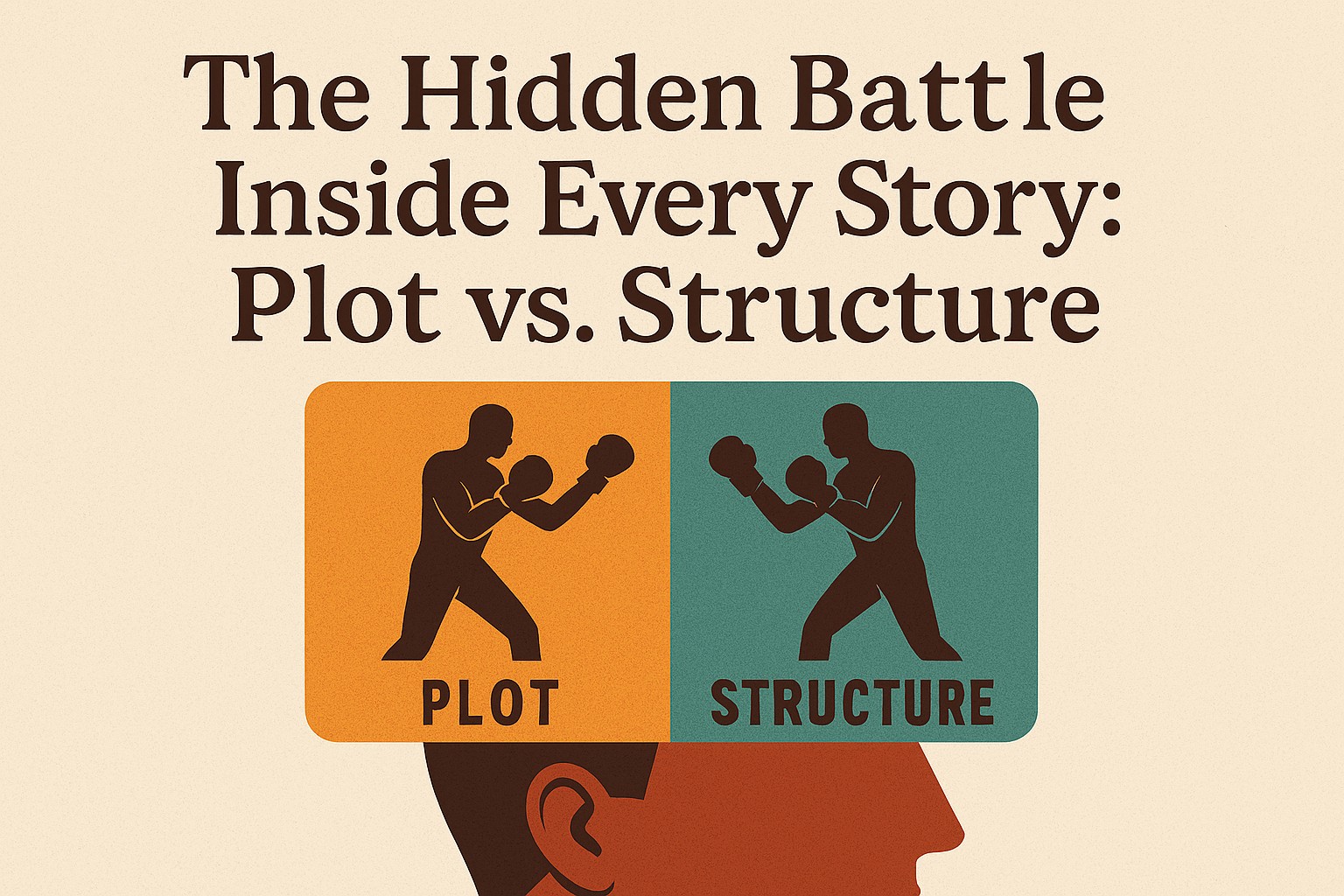
Plot is the story. Structure is the storytelling. Here’s a great analogy: Plot gets the punches. Structure wins the fight.
When you understand the difference, you stop writing events and start shaping experiences. You stop guessing where to put your twist and start engineering it. You stop hoping the story works and start making it inevitable.
And that’s where great writing lives—in the space where design meets discovery, where architecture meets emotion, where plot becomes story because structure gives it meaning.
Happy writing my friend, happy writing.
James




Leave a Reply